How to Stay Busy in Spain, When You're Working 12 Hour Weeks
(Sarah's Version)
1. Get into an exercise routine
I go running about four times a week. I run along the Río Genil, where there's a bit of a long narrow park popular with strolling couples and dog owners. The other day I had a rather large dog chase and bark at me for half a length of the river, which was pretty fun.
2. Take public transport.
When I'm working, I probably spend about 1.5 hours per day getting myself from home to work and back again. This pales in comparison to my Buenos Aires commutes, but it's still a lovely, relaxing part of the day (except when I have to run to catch the bus). Though the actual bus ride is only 20 minutes each way, it is an excellent time for jotting down ideas in my notebook and grinning to myself because of the fabulous views of the snow-topped Sierra Nevada, which look something like this on my bus ride. Sometimes I have trouble not singing to myself as I rock out to my iPod, and I must look quite silly to my fellow travelers.
3. Go out for tapas.
This is a great way to spend hours and hours. Go for dinner, go for a late night drink and snack, go in the afternoon for lunch. Tapas are all-purpose, and come in many varieties. We have two favorite tapas bars so far in Granada: Café om Kalsum for Moroccan flavors; Poë for other international flavors, mostly Brazilian.
4. When you're not eating tapas, always eat home cooked meals.
I cook every day, except for frozen pizza days, which come around about once a week. I have lots of time to cook, so if you have any recipes that don't require more than 30 minutes of oven time (ours starts to act up after that), send them my way! I've become a big fan of making banana chocolate chip (cut from a chocolate bar) pancakes on weekends: that is, sometime between Thursday and Sunday. This weekend I'm giving scones a second Spanish go-round for a friend's birthday.
5. Read.
Okay, so my reading so far hasn't exactly been educational, other than the 100 pages or so I've read of Multitude, but I swear, I will go to the library to get a card one of these days. But, I did read the entire Twilight series in eBook form, courtesy of a friend. (Stop judging me.) I'm also a big fan of Samanta Schweblin's short stories, and I've downloaded several Very Important Foundational Texts of Latin American Literature to get cracking on. I'm trying to stay up to date on American news by reading the Washington Post and Slate (my favorite!), but I tend to prefer watching their election sketch videos... Sarah the Diva! The Anti-America America in Pro-America America! The Mainstream Media Needs a Hug!
6. ...And I guess I've strayed into the realm of video.
Sometimes I watch episodes of classy television shows, like Gossip Girl and Supernatural, illegally on the internet. One of my flatmates -- who's a student, not a language assistant -- is addicted to TV series (her words, not mine), and routinely watches entire seasons of television shows. Today, to reward myself for SENDING IN MY VOTE I watched a Real Movie, which I'd brought with me on DVD. It's called Me Without You, and it was just about as heartbreaking as I remembered.
7. Commit to do something completely insane.
I'm participating in National Novel Writing Month, or NaNoWriMo for short, a writing project in which crazy people like me attempt to write a 50,000 word novel in November. I've been busy planning and plotting, and am very excited to start. I'm in the process of compiling a grocery list of novel-writing snacks to buy, and I've already stocked up on coffee. Anyone crazy enough to join in?
Some other day I'll write a more serious list of things to do in Spain, but really, this pretty much sums up what I've been doing recently. Let the mocking begin.
jueves, 30 de octubre de 2008

viernes, 24 de octubre de 2008
Ode to the French
Since coming to Aguilas I have to confess I have learned more French than Spanish thanks to my French roommate and his friends who often come to visit. Sadly, the phrases I use most are ferme ta gul (no idea if I spelled it right) and je suis sul (likewise). To save my reputation I'll let Sarah translate. My Spanish has improved a bit, however, since these kids all learned "proper" Spanish, or the Iberian variety, while I stick to manejar instead of conducir and aca instead of aqui. Earlier, when I commented on Sarah's post that I'd jumped into Castillian Spanish I didn't realize how deep the water was. So much of what I say gets my point across but sounds foreign and awkward to Spanish ears. I would never know this had it not been for my French comrades who constantly correct me; if only I had a euro for every time I heard no se dice eso en España (you don't say that in Spain). Merci bokou!
While my Iberian Spanish progresses step by step, my gastronomic adventures go by leaps and bounds. The short list of some crazy foods I've tried in the last few weeks:
Duck pate
Pig head pate
Pig body pate (God bless the French and their creativity with blended meats)
Fried fish testacles
Octopus (or squid?)
Not to mention all the normal Spanish food, tapas of every variety: potato omelet, potato sandwich (yup, just bread and potato, I love starch!!), pork and pepper sandwiches, jamon serrano and cheese, mushrooms (this is experimental for me), "salad" (which can be a mix of any kind of food, vegetables or no), chorizo and other sausasge varieties, and all kinds of fried fish and seafood. Thank god "mas por favor" is the same in every Spanish speaking country!
jueves, 23 de octubre de 2008
The Alhambra in Writerly Company
"I remember Granada as one should remember a sweetheart who has died." F.G.L

This weekend, I traveled to Granada, a city at the base of the Sierra Nevadas, to visit Sarah, my good friend and co-writer of this blog. As an added bonus, I was able to witness the native city of one of my favorite poets, Federico García Lorca, and to experience the tragic beauty of the place he often said had shaped him into the writer he was.

The highlight, not surprisingly, was the Alhambra, an astounding hilltop Moorish fortress that, in my opinion, more than lived up to its reputation as a nominee for the Seven Wonders of the World. Constructed in the 14th century by the Moors in an effort to mask their diminishing power, the Alhambra stands as a testament to the depth of the Arabs' influence in Spain and, in particular, Andalucía.

Lorca considered the Catholic Reconquest that followed the Alhambra's construction and ended Moorish reign a "disaster," since it destroyed a unique society in which Muslims, Jews and Christians had co-existed for seven centuries. Despite the Reconquest having taken place long before his time, he identified profoundly with those who had been unfairly accused, converted, and ultimately driven from their homes and country. "Being from Granada gives me a sympathetic understanding of those who are persecuted," he once wrote, "of the gypsy, the black, the Jew... of the Moor, whom all Grandinos carry with us."

For Lorca, the Alhambra epitomized this and all suffering. In his play "Doña Rosita the Spinster and the Language of Flowers," one of the characters calls the Moorish palace "a jasmine of grief." The water that filled the pools and fountains in the Alhambra, the adjacent gardens, and the two rivers that cut through the city below, was, to Lorca, the most somber element of all. Listening to the trickle of the fountains and the slow current of the dry rivers, the sad pulse of this ancient city and its history became real for me as well.

Personally, though, I felt more giddy from the incredible beauty of the Alhambra's design than depressed by the realization that its creators had been annihilated. Call me insensitive, but as I stood in one of the palace's courtyard, beside intricately molded stucco walls, finely carved wooden ceilings and elaborate muqarnas (honeycomb or stalactite) vaulting, all of which reflected in the central pools like an Islamic mirage of heaven, it seemed nothing less than a miracle that I could see such a thing in Western Europe at all.

For those of you who speak Spanish, here is an excerpt from Lorca's play Bodas de Sangre, a personal favorite of mine:
Leonardo:
¡Que vidrios se me clavan en la lengua!
Porque yo quise olvidar
y puse un muro de piedra
entre tu casa y la mía.
Es verdad. ¿No lo recuerdas?
Y cuando te vi de lejos
me eché en los ojos arena.
Pero montaba a caballo
y el caballo iba a tu puerta.
Con alfileres de plata
mi sangre se puso negra,
y el sueño me fue llenando
las carnes de mala hierba.
Que yo no tengo la culpa
que la culpa es de la tierra
y de ese olor que te sale
de los pechos y las trenzas.
Novia:
¡Ay que sinrazón! No quiero
contigo cama ni cena,
y no hay minuto del día
que estar contigo no quiera,
porque me arrastras y voy,
y me dice que me vuelva
y te sigo por el aire
como una brizna de hierba.
He dejado a un hombre duro
y a toda su descendencia
en la mitad de la boda
y con la corona puesta.
Para ti será el castigo
y no quiero que lo sea.
¡Déjame sola! ¡Huye tú!
No hay nadie que te defienda.
For more photos of my trip to Granada, check out my Facebook album "GRANADA"
Sources:
Gibson, Ian. "Literary Pilgrimages: Federico García Lorca." May 10, 1998. The New York Times. October 22, 2008. www.nytimes.com/books/98/05/10/specials/lorca.html
Stainton, Leslie. "The Granada of Federico García Lorca." May 4, 1986. The New York Times. October 22, 2008. http://query.nytimes.com/gst/fullpage.html?sec=travel&res=9A0EED81E3AF937A35756C0A960948260
miércoles, 22 de octubre de 2008
The Mothers of Pueblo Nuevo de Bullaque
Today I write from the smaller of the two schools that I work out throughout the week, named Pueblo Nuevo de Bullaque after the small pueblito in which it is located. There are only about 25 kids, ages 3 to 12, four professors, and thus the three classes that meet are smaller, more intimate, and mixed in terms of the grade levels.
I only go in on Wednesdays and work with each of the three classes, pre-k and 1st grade, 2nd and 3rd, 4th through 6th, and then, after the little recreo (recess) period, I meet with a handful of the parents and hold an English 101 session with them.
At first, that last bit was the most daunting and vergüenza-inducing bit of my week (vergüenza literally means "shame" but here, "hestitation" or fear"). The first day I arrived at the school, I was informed that I would meet the parents that same day. Immediately my mind went racing to figure out how to gague their prior-understanding, what topics to cover, and at what pace to move through the material. It obviously wasn't the most well-structured agenda and we bounced around quite a bit, but at the end of it I had come away with some important notes for the next class.
1) When they told me that they wanted to learn the most basic English, "o sea, lo más básico de lo básico," they meant it word for word --or perhaps even letter for letter.
2) I should plan it by topics that relate to topics that they would most likely need to use.
3) I should plan more than we will be able to cover in that one hour session.
It's only been three sessions, but I feel that the more recent two have been great improvements to the first. Today we reviewed salutations and good-byes and began to work on vocabulary and simple questions about the family (who's who, where do they live, how many ________ do you have, y ya está -- that's all), and I really came away from that lesson feeling that I had really done well and that a comfortable atmosphere had begun to develop within our little study group.
It's a very rewarding feeling to feel like you've helped someone, but I think there's more to it than that: I think they're helping me too. In "lo más básico" of terms and ways, after all these years of having it the other way, they're now helping me to understand how difficult it is to understand English and what it really means for one to speak too fast in his native tongue. Additionally, I'm learning how to properly form certain Spanish phrases, acquiring some new ones, and dropping some bad habits I've formed in my own acquisition of the language. There's a third and final part here that I haven't yet been able to articulate... I'll post it when it surfaces. Suffice to say, at the risk of sounding repetitive, it's a very good feeling and a rewarding experience.
On the whole, it's been a good week. Some teaching, some running in the park near the apartment, some football watching, and some good cooking. It's good to feel at one with the universe, even if you can't always say what's on your mind in the local language.
chau for now,
-Nick
lunes, 13 de octubre de 2008
Columbus Day, or the Challenge of Naming
Yesterday was Columbus Day, known here in Spain as the Día de la Hispanidad (Hispanic Day). The city of Granada celebrated with a parade, complete with two marching bands, an enormous Madonna, and many suited procession participants; in Madrid, I’ve read, the festivities include appearances by the Spanish royal family, an air show, and a military parade.
But what exactly are we celebrating, and why?
One way to approach the question is by considering the different names the holiday is known by around the world. As a very wise person once told me, words are never innocent, and naming is an act of creation that aims to establish a certain version of truth. That being said, onto the names.
Columbus Day (and the anti-Columbus Day movements)
In the U.S., the holiday is commonly known as Columbus Day. This is fairly straightforward: as the name indicates, we are commemorating the day that Christopher Columbus made landfall in the Americas: October 12, 1492 in the Julian Calendar. As children in the States, we are taught that Columbus discovered America, and celebrate his journey of almost mythical proportions across the sea "through sunshine, wind and rain" to the New World. Like the Founding Fathers, he is immortalized in statues and monuments, like this one I recently saw at Coit Tower in San Francisco:

Standing tall and majestic on the summit of Telegraph Hill, Columbus seems to be surveying the expanse of the San Francisco Bay, the American flag flying high before him. Perhaps the crucifix-laden explorer’s juxtaposition with the American flag over this West Coast bay is the symbol par excellence of the transformation of Columbus into a mixed and paradoxical metaphor in the U.S.: the epic oversea adventure of the Niña, Pinta, and Santa María as precursors to the voyage of the Mayflower; the quest for gold, glory, and later, expansionist power for the Crown as models for American manifest destiny; the triumph of Christianity over the savagery of the Americas as a reaffirmation of the nation’s Christian values (and a contradiction to the ideals of religious freedom).
Many people in the U.S. recognize the inconsistencies of celebrating Columbus while we laud life, liberty, and justice for all. In Berkeley, October 12 is celebrated as Indigenous People’s Day; in Denver, protesters are a yearly fixture at the Columbus Day parade; in Hawaii, advocacy groups reject the local version of the holiday, Discoverer’s Day, by celebrating indigenous cultures; in South Dakota, the holiday is Native American Day.
Day of the Race and Hispanic Day
Names emphasizing native cultures, such as those just mentioned and the Day of Indigenous Resistance in Venezuela (adopted following the 2002 arrival of Chávez to the presidency) can be contrasted with the more generic and less overtly political names Día de la Raza ("Day of the Race") and Día de la Hispanidad used in most of Latin America and in Spain, respectively.

Columbus Walk in Caracas, where the statue was knocked down by protesters in 2004.
The name "Day of the Race" originated in 1913 in a publication by the Unión Ibero-Americana in Madrid, with the holiday first being celebrated the following year by the same organization. The governments of Argentina and Spain followed in declaring the day a national holiday in 1917 and 1918, respectively. Implied by the name is the argument that what unites Spain and Latin America is a common racial heritage. For the Mexican ideologue and politician José Vasconcelos Calderón, this common racial heritage was what he called the raza cósmica ("the cosmic race"): a mixture of the "Black, Indian, Mongol, and White" races that resulted from the Spanish colonization of the Americas. According to his famous book of the same title, the "object of the new and old continent is much more important [than the project of English colonization]. Its predestination: to fulfill the mission of becoming the cradle of a fifth race in which all of the world’s peoples will fuse" (Calderón). Though Calderón took many positions on race that we’d now find absurd and offensive, his observations about racial mixing and the resulting cultural syncretism were important contributions to Latin American political thought.
Conversely, the concept of race as a unifying characteristic of Spain and Latin America was rejected by Ramiro de Maeztu, a Spaniard who in 1931 argued that the holiday should be celebrated as "Hispanic Day." According to Maeztu, "[h]ispanics are, then, all of those peoples who owe their civilization or their existence to the Hispanic peoples of the [Iberian] Peninsula. Hispanidad is the concept that includes them all" (Maeztu). Hispanidad, he argues, "is not a race" since "its composed of people of the White, Black, Indian, and Malay races, and their combinations." Maeztu next rejects Hispanic identity being a question of geography, "speaking the same language or of a shared community of origin, nor is it adequately expressed by calling it solidarity." Nevertheless, he believes that though the "spirit of Hispanidad is somewhat weak, it lives on. It manifests itself from time to time through expressions of solidarity and more, of community." It is not until the last paragraph of the text that Maeztu’s tautological definition is finally clarified: the Hispanic community is unified spiritually, by its Catholic heritage, which the author believes should also be the direction of the future (Maeztu).
That religion (a religion) is proposed as the key unifier of the Hispanic world in this foundational document of the holiday strikes me as very clearly problematic, and exclusivist: what about the very real religious diversity of the Latin world?. Still, in function, at least as the holiday is celebrated here in Spain, it is true that Catholicism does play a part in the festivities, such as the Madonna I mentioned in Granada’s parade.
So, it seems to be the case that all of the holiday’s names—Columbus Day, Day of the Race, Hispanic Day—are all beset with ambivalence. Are we celebrating, and do we want to celebrate a man who brought epidemic illness and destruction to a continent, a socially constructed concept that can be linked to many of the great injustices of human history, or a religious tradition that does not fully explain the diversity of Spain and Latin America? It seems that we are left with quite a dilemma, one which seems to me impossible to resolve. In the end, perhaps our best option is just to be aware of the problematic connotations of the holiday, its name, and its history, and to endeavor to approach it critically…while sitting back and enjoying the parade.
Interesting readings to peruse...
Columbus’s journal of his voyages to the Americas, as presented/edited by Bartolomé de las Casas
Columbus’s first letter to Santagruel, announcing the discovery
The complete children’s poem about Columbus
Sources
Calderón, José Vasconcelos. "Prólogo." La Raza Cósmica. Misión de la raza iberoamericana. Notas de viajes a la América del Sur. Barcelona: Agencia Mundial de Librería, ~1926. Proyecto Filosofía en español. 27 October 2005. La Fundación Gustavo Bueno. 13 October 2008
http://www.filosofia.org/aut/001/razacos.htm.
"Columbus Day." Wikipedia. 13 October 2008. Wikimedia Foundation, Inc. 13 October 2008
http://en.wikipedia.org/wiki/Columbus_Day.
"Día de la Hispanidad." Proyecto Filosofía en español. 27 October 2005. La Fundación Gustavo Bueno. 13 October 2008
http://www.filosofia.org/ave/001/a224.htm.
"Fiesta de la Raza." Proyecto Filosofía en español. 27 October 2005. La Fundación Gustavo Bueno. 13 October 2008
http://www.filosofia.org/ave/001/a220.htm.
"José Vasconcelos Calderón." Proyecto Filosofía en español. 31 March 2008. La Fundación Gustavo Bueno. 13 October 2008
http://www.filosofia.org/ave/001/a225.htm.
"José Vasconcelos Calderón." Wikipedia. 24 September 2008. Wikimedia Foundation, Inc. 13 October 2008
http://es.wikipedia.org/wiki/Jos%C3%A9_Vasconcelos_Calder%C3%B3n.
Maeztu, Ramiro de. "La Hispanidad." Acción Española I.i. Dec. 1913: 8-16. Proyecto Filosofía en español. 8 May 2006. La Fundación Gustavo Bueno. 13 October 2008
http://www.filosofia.org/hem/193/acc/e01008.htm.
But what exactly are we celebrating, and why?
One way to approach the question is by considering the different names the holiday is known by around the world. As a very wise person once told me, words are never innocent, and naming is an act of creation that aims to establish a certain version of truth. That being said, onto the names.
Columbus Day (and the anti-Columbus Day movements)
In the U.S., the holiday is commonly known as Columbus Day. This is fairly straightforward: as the name indicates, we are commemorating the day that Christopher Columbus made landfall in the Americas: October 12, 1492 in the Julian Calendar. As children in the States, we are taught that Columbus discovered America, and celebrate his journey of almost mythical proportions across the sea "through sunshine, wind and rain" to the New World. Like the Founding Fathers, he is immortalized in statues and monuments, like this one I recently saw at Coit Tower in San Francisco:
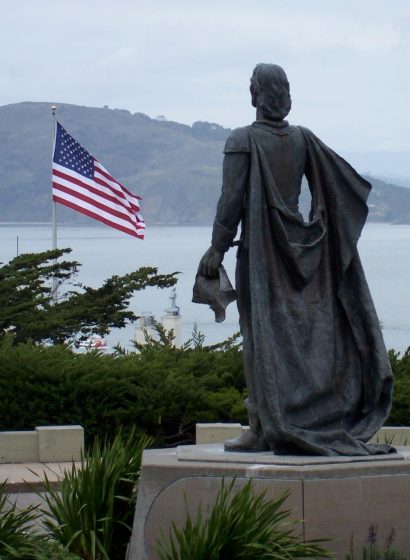
Standing tall and majestic on the summit of Telegraph Hill, Columbus seems to be surveying the expanse of the San Francisco Bay, the American flag flying high before him. Perhaps the crucifix-laden explorer’s juxtaposition with the American flag over this West Coast bay is the symbol par excellence of the transformation of Columbus into a mixed and paradoxical metaphor in the U.S.: the epic oversea adventure of the Niña, Pinta, and Santa María as precursors to the voyage of the Mayflower; the quest for gold, glory, and later, expansionist power for the Crown as models for American manifest destiny; the triumph of Christianity over the savagery of the Americas as a reaffirmation of the nation’s Christian values (and a contradiction to the ideals of religious freedom).
Many people in the U.S. recognize the inconsistencies of celebrating Columbus while we laud life, liberty, and justice for all. In Berkeley, October 12 is celebrated as Indigenous People’s Day; in Denver, protesters are a yearly fixture at the Columbus Day parade; in Hawaii, advocacy groups reject the local version of the holiday, Discoverer’s Day, by celebrating indigenous cultures; in South Dakota, the holiday is Native American Day.
Day of the Race and Hispanic Day
Names emphasizing native cultures, such as those just mentioned and the Day of Indigenous Resistance in Venezuela (adopted following the 2002 arrival of Chávez to the presidency) can be contrasted with the more generic and less overtly political names Día de la Raza ("Day of the Race") and Día de la Hispanidad used in most of Latin America and in Spain, respectively.

Columbus Walk in Caracas, where the statue was knocked down by protesters in 2004.
The name "Day of the Race" originated in 1913 in a publication by the Unión Ibero-Americana in Madrid, with the holiday first being celebrated the following year by the same organization. The governments of Argentina and Spain followed in declaring the day a national holiday in 1917 and 1918, respectively. Implied by the name is the argument that what unites Spain and Latin America is a common racial heritage. For the Mexican ideologue and politician José Vasconcelos Calderón, this common racial heritage was what he called the raza cósmica ("the cosmic race"): a mixture of the "Black, Indian, Mongol, and White" races that resulted from the Spanish colonization of the Americas. According to his famous book of the same title, the "object of the new and old continent is much more important [than the project of English colonization]. Its predestination: to fulfill the mission of becoming the cradle of a fifth race in which all of the world’s peoples will fuse" (Calderón). Though Calderón took many positions on race that we’d now find absurd and offensive, his observations about racial mixing and the resulting cultural syncretism were important contributions to Latin American political thought.
Conversely, the concept of race as a unifying characteristic of Spain and Latin America was rejected by Ramiro de Maeztu, a Spaniard who in 1931 argued that the holiday should be celebrated as "Hispanic Day." According to Maeztu, "[h]ispanics are, then, all of those peoples who owe their civilization or their existence to the Hispanic peoples of the [Iberian] Peninsula. Hispanidad is the concept that includes them all" (Maeztu). Hispanidad, he argues, "is not a race" since "its composed of people of the White, Black, Indian, and Malay races, and their combinations." Maeztu next rejects Hispanic identity being a question of geography, "speaking the same language or of a shared community of origin, nor is it adequately expressed by calling it solidarity." Nevertheless, he believes that though the "spirit of Hispanidad is somewhat weak, it lives on. It manifests itself from time to time through expressions of solidarity and more, of community." It is not until the last paragraph of the text that Maeztu’s tautological definition is finally clarified: the Hispanic community is unified spiritually, by its Catholic heritage, which the author believes should also be the direction of the future (Maeztu).
That religion (a religion) is proposed as the key unifier of the Hispanic world in this foundational document of the holiday strikes me as very clearly problematic, and exclusivist: what about the very real religious diversity of the Latin world?. Still, in function, at least as the holiday is celebrated here in Spain, it is true that Catholicism does play a part in the festivities, such as the Madonna I mentioned in Granada’s parade.
So, it seems to be the case that all of the holiday’s names—Columbus Day, Day of the Race, Hispanic Day—are all beset with ambivalence. Are we celebrating, and do we want to celebrate a man who brought epidemic illness and destruction to a continent, a socially constructed concept that can be linked to many of the great injustices of human history, or a religious tradition that does not fully explain the diversity of Spain and Latin America? It seems that we are left with quite a dilemma, one which seems to me impossible to resolve. In the end, perhaps our best option is just to be aware of the problematic connotations of the holiday, its name, and its history, and to endeavor to approach it critically…while sitting back and enjoying the parade.
Interesting readings to peruse...
Columbus’s journal of his voyages to the Americas, as presented/edited by Bartolomé de las Casas
Columbus’s first letter to Santagruel, announcing the discovery
The complete children’s poem about Columbus
Sources
Calderón, José Vasconcelos. "Prólogo." La Raza Cósmica. Misión de la raza iberoamericana. Notas de viajes a la América del Sur. Barcelona: Agencia Mundial de Librería, ~1926. Proyecto Filosofía en español. 27 October 2005. La Fundación Gustavo Bueno. 13 October 2008
http://www.filosofia.org/aut/001/razacos.htm.
"Columbus Day." Wikipedia. 13 October 2008. Wikimedia Foundation, Inc. 13 October 2008
http://en.wikipedia.org/wiki/Columbus_Day.
"Día de la Hispanidad." Proyecto Filosofía en español. 27 October 2005. La Fundación Gustavo Bueno. 13 October 2008
http://www.filosofia.org/ave/001/a224.htm.
"Fiesta de la Raza." Proyecto Filosofía en español. 27 October 2005. La Fundación Gustavo Bueno. 13 October 2008
http://www.filosofia.org/ave/001/a220.htm.
"José Vasconcelos Calderón." Proyecto Filosofía en español. 31 March 2008. La Fundación Gustavo Bueno. 13 October 2008
http://www.filosofia.org/ave/001/a225.htm.
"José Vasconcelos Calderón." Wikipedia. 24 September 2008. Wikimedia Foundation, Inc. 13 October 2008
http://es.wikipedia.org/wiki/Jos%C3%A9_Vasconcelos_Calder%C3%B3n.
Maeztu, Ramiro de. "La Hispanidad." Acción Española I.i. Dec. 1913: 8-16. Proyecto Filosofía en español. 8 May 2006. La Fundación Gustavo Bueno. 13 October 2008
http://www.filosofia.org/hem/193/acc/e01008.htm.
Waxing poetic
After the storm passes the silhouettes of palm trees fade into the misty horizon. The chilly water reflects the hazy sunset as one brave bather steps in and slowly sinks into that glowing vastness. As his head goes underwater he disappears completely. This is the vision of my Spain


España. I wanted to write about how living here is more of a sensory experience than I have had in the United States, but I can hardly concentrate on writing as I listen to and watch everything that goes on around me. A little boy bangs against a metal see-saw, a group of young Arab boys play fights, an old couple slowly walks by and two ladies in sweat suits jog by. Cars, bicimotos, children, dogs, teenagers, music, birds, whistles, boats, breeze, cries of joy, cries of excitement, skimpy bathing suits, and waves crashing fill my head.


In


But the most prominent smell is the ocean; it’s always there, faintly, behind all the other smells. It’s so subtle that sometimes you hardly notice it until you take a deep breath. But in the morning that smell fills me up. It reminds me that a long time ago doctors used to send their patients to the ocean because of its healing effects. As I walk along the promenade, the sun rising behind the rocky cliffs ahead, the breeze off the sparkling water is thick and salty and reminds me of fishermen. The sea spray wets the sidewalk when the waves crash against the rocks. Every morning when I pass that rocky spot with the sea spray I take a deep breath and smile.

"A computer in every classroom" and a statue of Cervantes in every city
Last Wednesday, CRA Valle de Bullaque, the school where I work, was given a very special honor: our humble cole (their nickname of endearment for colegio, the word for school) was to be made the place where the president of the region of Castilla-La Mancha, José María Barreda, would officially inagurate his campaign to place a new computer into every classroom throughout the region (note: both links are in Spanish). Needless to say, it was quite the event with much pomp, circumstance, and politiking. But before any of that could get underway, organized preparations were called for so that the school, already situated in a new and attractive building, could be made all the more so with, among other things, decorative hands and feet colored in by students and professors alike that adorned and scaled the perimeter of the halls next to signs that read "avanzamos juntos" and "growing together" (my personal, much thought about figurative translation for it).


The president was also to come into three classes in the school during his visit, each in a different wing of the building: one in the infantil wing (the pre-schoolers), one in the primer ciclo (first or second grade), and one in tercer ciclo (fifth or sixth grade), and I was to be in the second grade class, playing a game of Simon Says with the kids. Qué suerte tengo yo, ¿eh? (what luck, eh?)
The day before Barreda came, I went up to the class to explain and practice the game with them. I never imagined how difficult it would be to explain in English, much less explain it in Spanish, but I came prepared with notes on how I would do so and thankfully Zorida, the teacher, assisted my explanations very well.
Equally providential, the kids enjoyed the game -- as kids will any game I suppose -- and the following day, the "lesson" went off without a hitch... for me at least . It seemed that with all the excitement of having the president there... and the press... and their cameras and bright lights and all -- it was all too much for some of the kids who instead of following me just stared out dumbfounded at the whole production around us. It was still very cute and fun to be a part of. Check out this link to get a taste for how it went down.
After the day's very exciting and a bit over-stimulating proceedings -- including a fantastic tapas spread for the professors past and present of the cole -- I headed to Madrid to celebrate the Yom Kippur holiday with one of the congregations there, and also to enjoy some possible weekend excursioning. Thus, not only did I pass a day or two in Madrid, but I also broke the Yom Kippur fast on medieval-style treats in Alcalá de Henares during a festival honoring the birthday of Miguel de Cervantes of Don Quijote fame, and spent Saturday in Toledo with another friend from UMD before coming back yesterday to do laundry, clean my room, and return to the quotidian flow of life once more.
Speaking more or less of Cervantes, this man seems to be a bigger deal here in Spain than George Washington is in the United States, because he is adored and celebrated in every town in this country. At least, that is, in Madrid and in Castilla-La Mancha where there is a statue of the laureate, a plaza in his name, or both. And no two statues are the same. In Alcalá de Henares, his birthplace, he stands magestically on a pillar, plumed feather pen in hand; in Toledo he stands tall and lean, book under his bronzed arm, looking out at the masses that come up the steep city street; and in Ciudad Real, peculiarly enough, he is seated in a lavish chair... just chillin' it would appear. It's very funny.
Finally, a word on Toledo before I sign off. Once the capital of the Spanish empire, Toledo still commands a sort of royal splendor and continues to tempt and inspire many a traveler, both local and foreign alike to its gates. Our bus ride into town was preceded and escorted in by a substantial downpour, but thankfully by the time we left the bus at the Plaza de Zocodover the rains had subsided, and by lunchtime the sun had even begun to make its way through the clouds. I highly recommend it to anyone staying for a few days in Madrid or the surrounding area, but then again, I would also recommend that you come see me while you're around.
I leave you with some photos taken of my last week's adventures. Nos vemos!
-Nick
(the above photos from l to r: statues of Cervantes in Alcalá and in Toledo)
the tapas spread from Wednesday's luncheon
Justin engages a bakery merchant in Alcalá
the best Don Quijote impersonator I ever did see
the best Sancho Panza impersonator i ever did see (comes with free sheepskin flask!)
views from Toledo: inside an old convent turned museum and from one of the many wonderful hilltop vistas
THIS. IS. TOLEDO!!!
a little color in a town of weathered stone
from the Museo Sefardí (Museum of Judeo-Spanish History)
Suscribirse a:
Entradas (Atom)


